

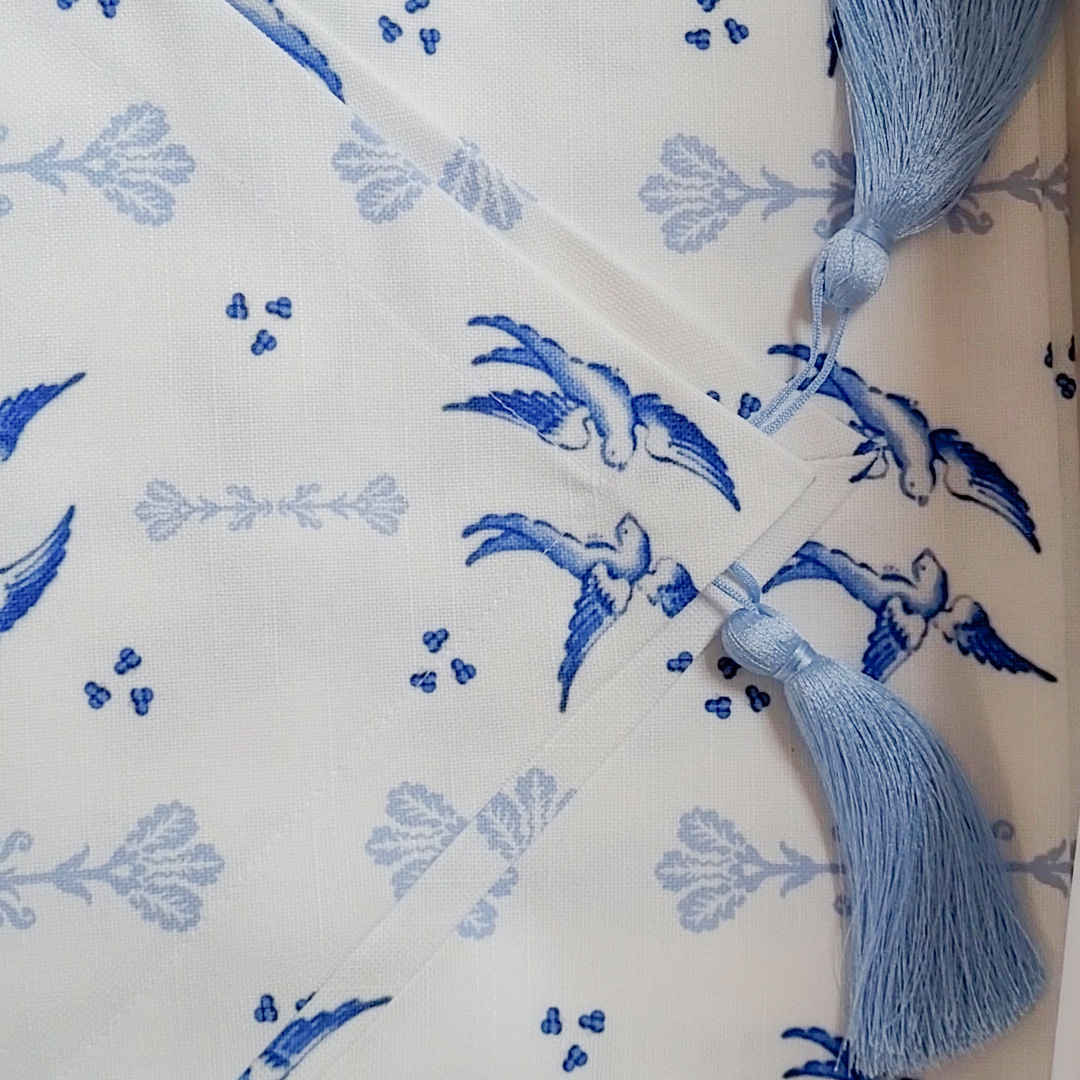
How a heritage pattern designer turns family memory into meaningful surface design — and why it matters more than ever.
Some objects carry more than memory. A teacup used every morning for forty years. A fragment of wallpaper from a childhood bedroom. A tablecloth that appeared at every family gathering without fail. These things hold something that trends never quite manage — continuity, identity, the quiet weight of being loved.
Which raises a question worth asking:
Can a surface pattern actually preserve family history?
It can — when the design process begins not with trend boards, but with storytelling.
In this article, I want to share how a childhood memory connected to the famous Willow Pattern became the foundation of a bespoke textile commission for a young family. Along the way, I’ll introduce my own design approach — the Memory Thread Method — and explain why heritage-led pattern design is finding its moment right now.
The story behind this commission
The brief came out of an ordinary lunch conversation about interiors, objects, and the things we keep. My colleague had just acquired a new dining table — beautiful and full of potential — and wanted something made for it. Something with meaning.
Here’s the thing about those kinds of conversations: they have a way of going somewhere unexpected.
He mentioned his grandfather, Ireland in the early years of his childhood, and a blue-and-white teacup that was used every single day without exception — part of a Willow Pattern tea set that had lived in the kitchen for as long as anyone could remember.
That was it. That was the whole brief.
Not a mood board. Not a trend reference. A teacup and the man who drank from it every morning. That became the emotional foundation of the entire pattern.
Why the Willow Pattern still holds
The Willow Pattern originated in late 18th-century England — heavily inspired by Chinese blue-and-white porcelain, though entirely English in its storytelling. The design is quietly theatrical: a pagoda, a bridge with figures crossing it, water, a boat, two birds in flight, and the weeping willow that gives it its name.
It also tells a story. A tragic one, as it happens — forbidden love, pursuit, transformation. In Ireland, this pattern moved into daily life: tea services, dinner sets, handed-down objects that became part of how families organised their mornings and their celebrations.
What interests me as a heritage pattern designer is precisely this shift — from visual language to emotional language. The pattern stopped being a story and became a ritual. And rituals, accumulated over time, become heritage.
That’s the material I work with.
The Memory Thread Method: my signature design process
Most pattern design begins with reference imagery or trend forecasting. My process begins earlier — with the object or person the client can’t stop thinking about when they imagine home.
I call this the Memory Thread Method: a heritage-led design framework that traces the emotional thread between a personal memory and a contemporary surface pattern.
It works in three steps.
Step 1 · Find the emotional object
This might be a grandmother’s embroidered linen, old ceramic tiles, a garden gate, a recipe book with handwritten margins, or a teacup used every morning for decades. The object itself is only the entry point. What matters is what it was connected to — the person, the place, the daily ritual that made it significant.
Step 2 · Locate the memory in a place or person
The most vivid design references I’ve encountered are almost always tied to a specific geography of feeling: the kitchen where tea was made every morning, the floral curtains seen through a childhood bedroom window, a Sunday table that was always laid a particular way. These emotional anchors are what give a pattern authenticity that purely aesthetic references simply cannot replicate.
Step 3 · Translate memory into motif
This is where heritage storytelling becomes surface pattern design — where historical motifs, symbolic shapes, textile references, and personal narratives are reinterpreted into something contemporary. The result might be table linen, wallpaper, fabric, homeware, or hospitality textiles. What it will always be is specific: belonging unmistakably to one story, one family, one inheritance.
Why heritage-inspired surface design matters now
There’s a reason this kind of work is gaining ground. In a market oversaturated with fast-moving aesthetics and disposable interiors, people are increasingly drawn to objects that feel earned — that carry the logic of continuity rather than novelty.
Heritage pattern design doesn’t reject the contemporary. Done well, it does something more interesting: it brings the past and present into contrast with each other, so that both are made more vivid. The old motif looks sharper against a modern setting. The modern interior feels warmer with history layered into it.
A custom surface pattern, approached this way, can become a future heirloom — a visual family archive, a conversation piece, a way of carrying identity forward rather than starting from scratch each generation.
The pattern I made for that family now lives on their dining table. Their son, who was a newborn at the time of the commission, will grow up at that table — hearing stories, sharing meals, perhaps never thinking twice about the blue birds in the linen. Or perhaps one day asking about them.
That’s the long game of this work. And it’s one I find genuinely worth playing.
Working with a heritage pattern designer
My practice is built around bespoke commissions — custom surface patterns rooted in family history, cultural heritage, historical textiles, and personal storytelling. The work finds its way into table linen, wallpaper, fashion textiles, and hospitality interiors.
If you have an object, a memory, or a tradition that feels as though it deserves a longer life — I’d be glad to hear about it.