

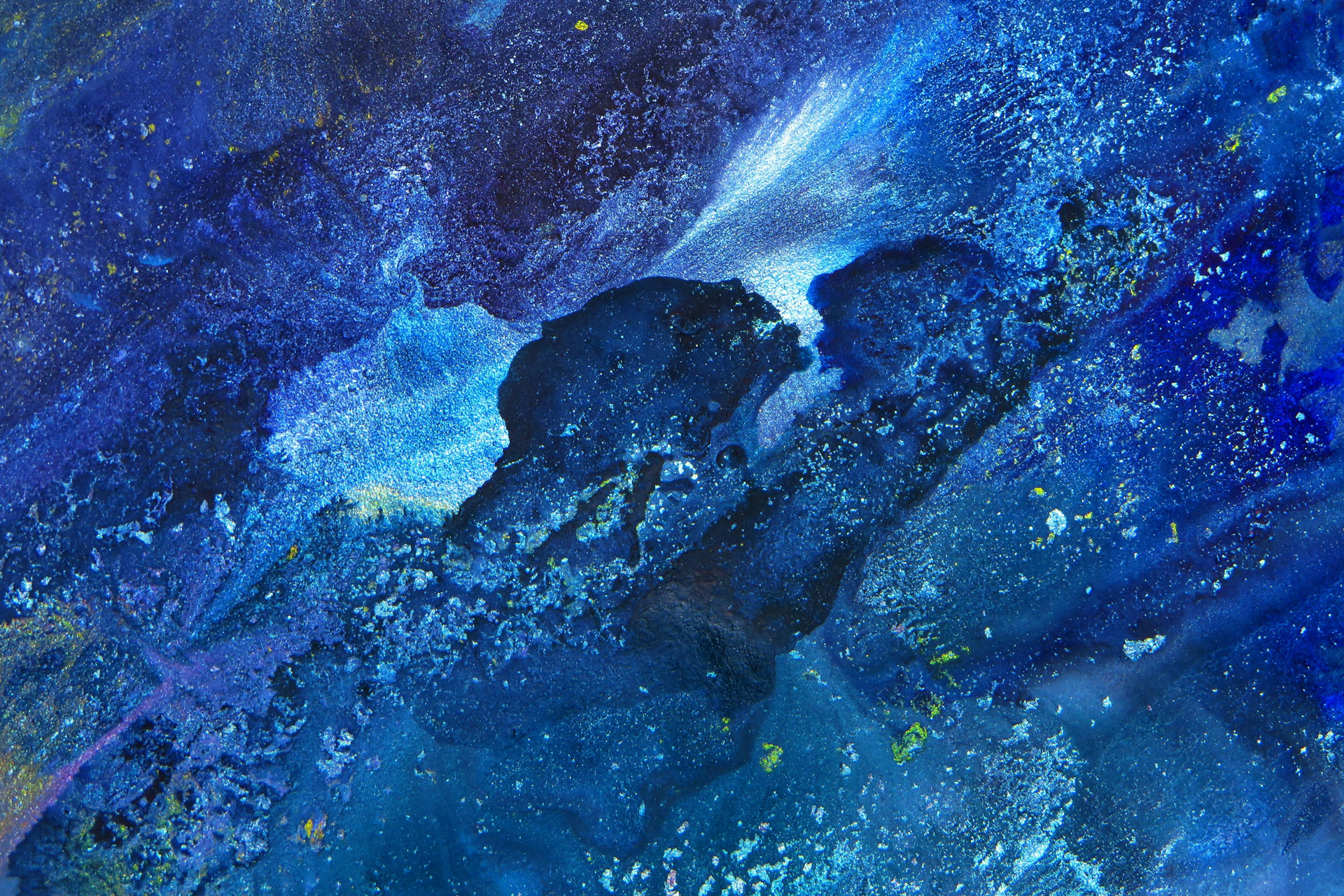
The Most Quietly Powerful Combination in Design
I’m often asked why blue shows up so persistently in my work. Honestly? I didn’t plan it that way. It’s not as though I sat down one day and declared blue my signature. It crept in, stayed, and made itself at home. And the more I’ve thought about it, the more I’ve come to believe it was never really a choice. More of a recognition.
Let me explain.
The World’s Favourite Colour (and Why That’s No Accident)
Here’s something that genuinely fascinates me: across cultures, across continents, across centuries, blue consistently ranks as the world’s favourite colour. Not red, not green. Blue. Every time.
Perhaps because it surrounds us constantly. The sky above, the sea at the horizon, the particular quality of light on a clear morning. Blue is both the most expansive thing we can look at and somehow, at the same time, deeply calming. It slows the breath. It softens the edges of a room. It creates trust in a way that’s almost impossible to explain but immediately felt.
For a pattern designer, is there a better foundation to build on?
The Colour That Once Cost More Than Gold
If I had to put my finger on why blue feels so right for heritage-inspired work specifically, it comes down to this: blue carries history in a way that very few colours do.
For centuries, true blue was extraordinarily rare and breathtakingly expensive. The most prized of all was ultramarine, made from lapis lazuli, a semi-precious stone mined in Afghanistan and transported across continents before it ever reached a painter’s studio. It cost more than gold. During the Renaissance, Michelangelo, Leonardo da Vinci, and Jan van Eyck used it sparingly and deliberately, often reserving it for the robes of the Virgin Mary. It wasn’t merely a colour. It was reverence. It was devotion. It was the visual language of what mattered most.
Even before that, ancient civilisations had developed Egyptian blue, one of the first synthetic pigments in human history, though the formula was eventually lost for centuries. Blue has always been something people worked hard to possess, preserve, and pass on.
That history doesn’t disappear when you look at a beautifully dyed textile today. It lingers. And I think we feel it, even when we can’t name it.
Why Blue and White Together Is Something Else Entirely
Blue alone is magnificent. Blue paired with white is something else entirely.
Think about it for a moment. Ming porcelain. Delft tiles. Wedgwood. The Willow Pattern. Greek island architecture. French Toile de Jouy. These are not just aesthetic references: they are some of the most enduring, universally recognised symbols of refinement and cultural sophistication that exist. And every single one of them is built on the same two colours.
There is something about blue and white together that reads, across every culture and every era, as the quiet language of luxury. Not the loud, look-at-me kind. The kind that has nothing to prove. The kind that has simply always been there, on the best tables, in the finest rooms, at the moments worth remembering.
It’s a combination that feels both timeless and alive, which is exactly the tension I’m drawn to in my work.
Blue and White Patterned Table Linen
There is a difference between a table dressed in blue and a table told in blue and white. A few blue napkins and matching candles is a colour choice. But when a pattern weaves the two together across the cloth, connecting to the stationery, the place cards, the small details that guests notice and quietly remember, that’s something else. That’s a visual story. And at a celebration, that distinction matters more than people might expect.
It’s a conversation I’m looking forward to continuing in a dedicated post on styling event tables with patterned linen. Watch this space.
In the meantime, I’d love to know what blue means to you. Come and find me on Instagram at @danielegaube