

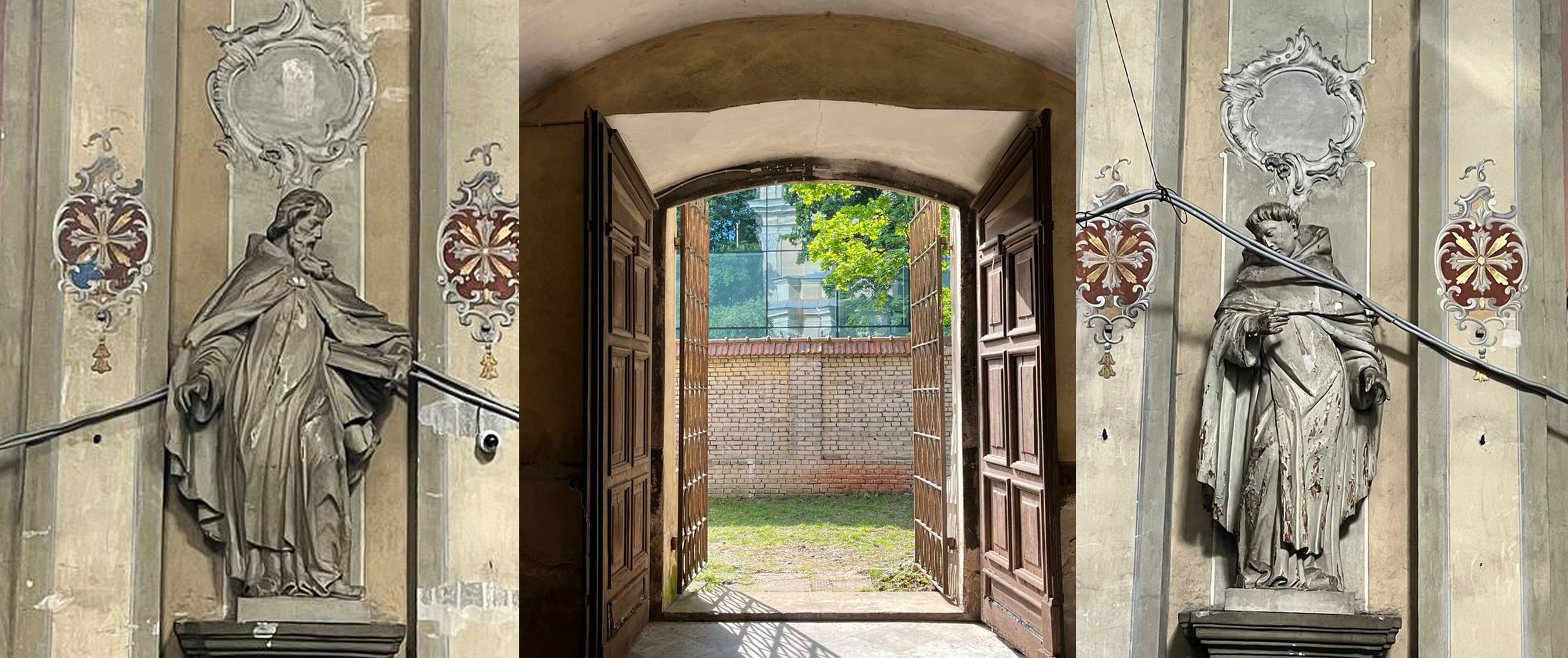
Stepping Into Frozen Time
There are moments in a creative life that stop you completely. Not the kind of stopping that comes from being stuck or uncertain, but the kind that comes from being suddenly, unexpectedly in the presence of something that asks you to be still and pay attention. Walking into St. George’s Church in Vilnius for the first time was one of those moments.
The church had been closed to the public for decades. Its recent reopening felt quietly significant — not just as a cultural event, but as an opportunity of the kind that does not come often. Because what waited inside was not a restored interior. Not the kind of carefully maintained, repainted, updated space that most historic churches present to the world. What waited inside was something far rarer: a place frozen in time.
What Remains
As a pattern designer, I enter spaces differently to most people. I am not always looking at the whole. I am looking at colour relationships, at the way pigment ages and shifts, at motifs and symbols and the decisions of people who worked with their hands centuries before me. In a restored church, that direct encounter is largely gone. What you see is an interpretation, a later hand’s idea of what the original might have looked like.
St. George’s offered something else entirely. The paint strokes on these walls were made by artists working under commission from the grand families of their time. The colours — muted rose, warm grey, faded ochre, pale plaster white — had not been chosen by a restoration team. They had simply survived. Quietly, stubbornly, without intervention.
Alongside the artistry there were other traces too. Holes knocked through walls with complete disregard. Electrical wires draped across painted figures of saints. Evidence of the full complicated history of a building that has passed through many hands, not all of them careful. That contradiction — extraordinary beauty and rough human carelessness existing in the same space — made the experience more honest, not less.
A Sensory Overload That Lingers
Walking through that interior I felt what I can only describe as a creative overload. Colour everywhere, not as decoration but as information. Texture in every surface. Motifs half-visible beneath layers of time. It is the kind of experience that does not resolve itself immediately into a design decision. It settles more slowly, rippling through the work over weeks and months, surfacing in choices that feel instinctive but are actually deeply sourced.
Every colour in my Carnations in Art collection — submitted to the TWOPAGES Curtain As Art Competition 2026 — comes directly from that interior. The dusk rose, the neutral grey, the warm near-white background. These are not trend colours. They are not chosen from a forecasting report. They are the colours that have survived on those walls for centuries, and I believe that is precisely why they work together with such quietness and certainty.
Why Source Matters
There is a particular kind of confidence that comes from knowing exactly where your work comes from. Not just a general inspiration — a painting, a period, a mood — but a specific place, a specific light, a specific afternoon standing in front of walls that people touched hundreds of years ago.
That specificity is what I am always looking for as a designer. It is what separates a pattern with a genuine point of view from one that merely resembles something historical. The difference is not always visible at first glance. But it is always present in the work.
If you would like to see the collection that came from that afternoon in St. George’s, I have shared some of it on Instagram at @danielegaube. And if you find yourself in Vilnius while the church remains open, go. Bring your most patient, attentive eyes.